

№ 15: Data
I’m the sort of nerd who likes collecting and organizing data. Thus, when out climbing trees, I go to probably absurd lengths to document my activities. The value of my information is dubious, but it pleases me to accumulate it.
This all began in 2019, when I started getting “serious” about climbing trees (i.e., not just doing it once every couple years, but pursuing it as a more intentional hobby). I started a spreadsheet to make note of the location of each tree that I climbed. This was intended to make it easier for me to return to a climbing place, but also, I secretly hoped, it might someday help someone else, if I ever made friends with another local arboreal enthusiast.
Besides the tree’s location (in latitude and longitude, as determined by poking around at Google satellite imagery on my phone), I also noted my opinion of how enjoyable the tree was. Basically, whether I thought it was worth coming back to. For this, I made up a four-level rating scale: unremarkable < sufficient < worthwhile < quality. I am wildly inconsistent in applying this scale, and it would be largely useless to anyone else. I also added a sentence or two of notes, describing a tree’s interesting climbing features, or lack thereof.
That spreadsheet was a simple, and arguably practical, start: where to find trees, whether to come back to them, and what to expect when climbing them. But, as time went on, things spun out of control, and I collected more and more information each year.
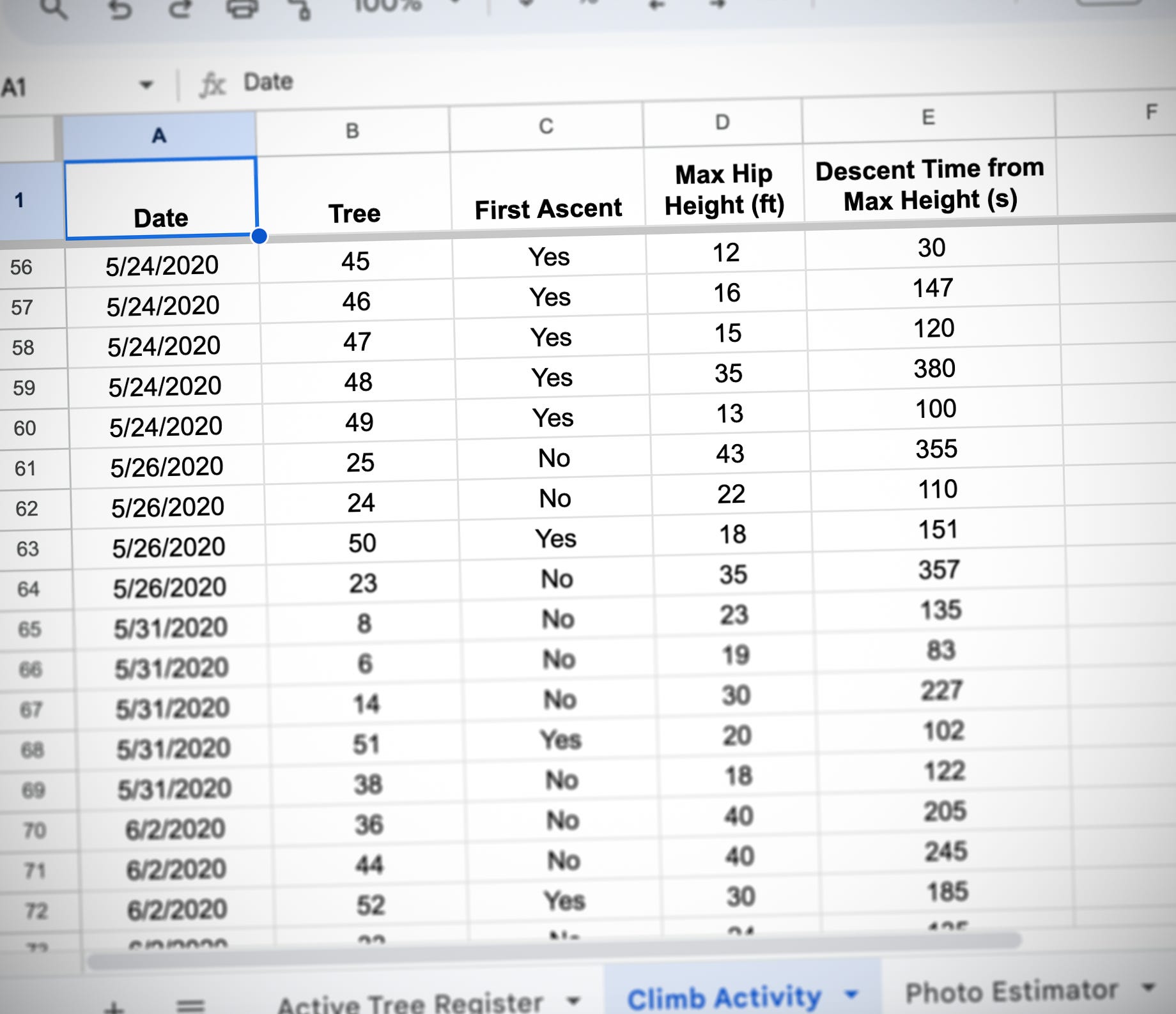
At this point, I now have two spreadsheets. One tracks every single individual climbing experience: which particular tree I climbed, whether it was my first time in that tree, when I climbed it, how high I climbed, and how long it took me to descend from that tree.
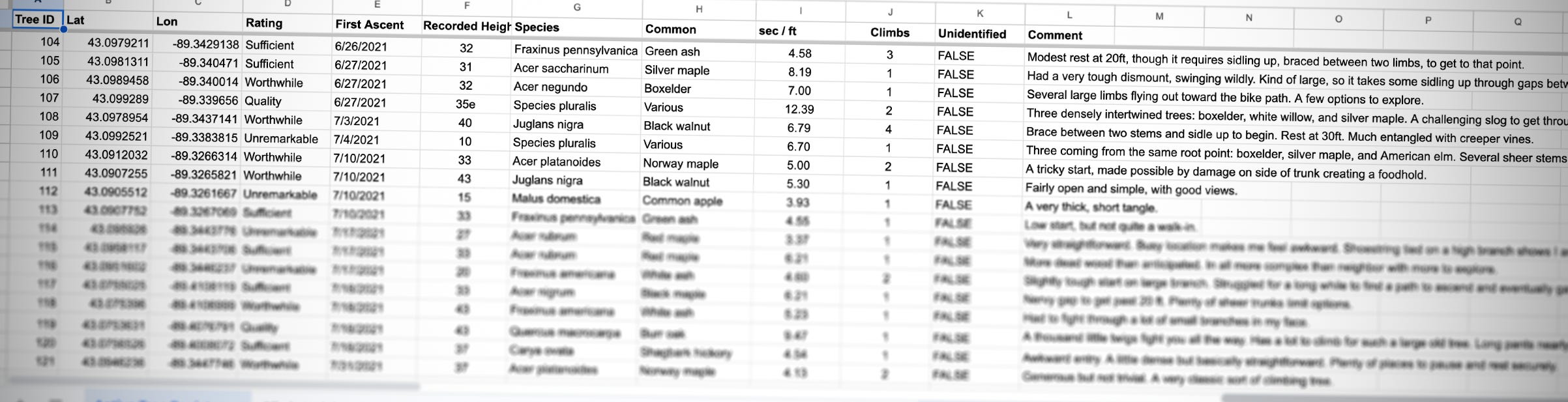
The other spreadsheet summarizes each tree that I have climbed. It includes: a unique ID number for the tree, its location, my personal rating of that tree, the day I first climbed it, the highest I’ve climbed in that tree, its species (common and scientific names), the number of times I’ve climbed it, and a sentence or two of comment. I also calculate a “slowness percentile,” which is a statistic that is intellectually interesting but has not proven particularly useful. I use the height and descent time from each individual climb of that tree to calculate how fast, on average, I have moved through the tree. This is meant as a proxy for how effortful the tree is: some trees you can glide easily through, and some are quite challenging.
Clearly, I am out of control.
But, while I rarely use most of the information that I record, it’s still fun to keep track of. That’s just how my brain works. And maybe someday another Madisonian climber will be aided by my documentation.
For now, though, the main benefit to me is simply knowing where to find trees I’ve climbed before. I regularly transfer the contents of my observations to Google Maps, so that when I’m out and about, I can look at my phone and know what trees are nearby.
But once I’m in from a day of climbing, I also get some satisfaction from looking over my spreadsheets for personal records and statistics. You’ve seen charts in some of my previous letters, derived from my documentation: while those don’t affect my climbing, it’s fun to reflect. I can tell you how many climbs I’ve made in a year, or the greatest heights I’ve achieved.
Speaking of, I have been asked a few times before: how do I measure my elevation? In an earlier letter, I talked about bringing a laser ruler with me. Most of the time, that’s sufficient. I measure the distance between my hips and the ground directly below. It usually takes a few tries to get a consistent measurement: lasers don’t bounce really well off dirt and grass. If that doesn’t work, I will take photographs of objects on the ground (manhole covers, a water bottle I’ve left there, a big stick, etc.), and later on calculate my distance to that object based on its known size and the number of pixels it takes up in the photograph. Finally, if that’s not easily possible (perhaps the ground is obscured by many branches or leaves), I will measure the tree in segments. I will use my laser ruler to measure my distance to some spot partway down the tree, climb to that spot, and then measure to another intermediate spot, etc., and then I will sum the distances.
While my climb documentation has continued to get more extensive each year, I’ve pondered cutting back, especially on some of the fuzzier stuff. My ratings aren’t really useful, even to me. If I liked a particular tree, I’ll remember it and want to come back; otherwise, it doesn’t matter; I’ll probably climb it if I’m nearby and feel like it at that particular moment, regardless of how it’s rated.
The notes I make about each tree vary greatly in length and quality of information they provide. Some examples:
“Deep notch forms an unexpected handhold at the lowest junction, but it’s still a tough start. Work your way left to get going. Sharp bark and not much to explore when aloft.”
“Easy start, and then trickier halfway up. Fastigiate. To get up high, some squeezing and dodging between trunks, before topping out on thin branches.”
“A pretty unremarkable climb, one of many in this location.”
“Fairly open and spreading”
I rarely read these past comments before climbing, so even when they say something useful, I don’t really benefit. Mostly, at this point, I’m writing them because it’s a habit. Instead of filling space, I’ve begun to work on writing only things that might actually be useful or interesting.
I wonder if one reason that I do all this is to make my hobby feel more “adult.” I’ve written before about how tree climbing is seen as child’s play, and how many adults compensate for that by purchasing a lot of gear. While I don’t invest a lot into gear, devoting so much effort to being analytical perhaps serves some of the same purpose. It’s my natural inclination anyway, but it might also make me feel like I’m engaging in a “serious” and “athletic” pursuit, and allow me to present it to others in a way that they might respect more. That’s just idle speculation, but I should ponder it more.
Note: Due to some ongoing health challenges that have significantly reduced my capacity, my next letter may be delayed an undetermined amount of time. I look forward to sharing more tree musings with you when I am able to return. Until then, have a happy New Year!